Groundbreaking Study Reveals Procrastination Actually Caused by Microscopic Time Thieves Living in Human Brain
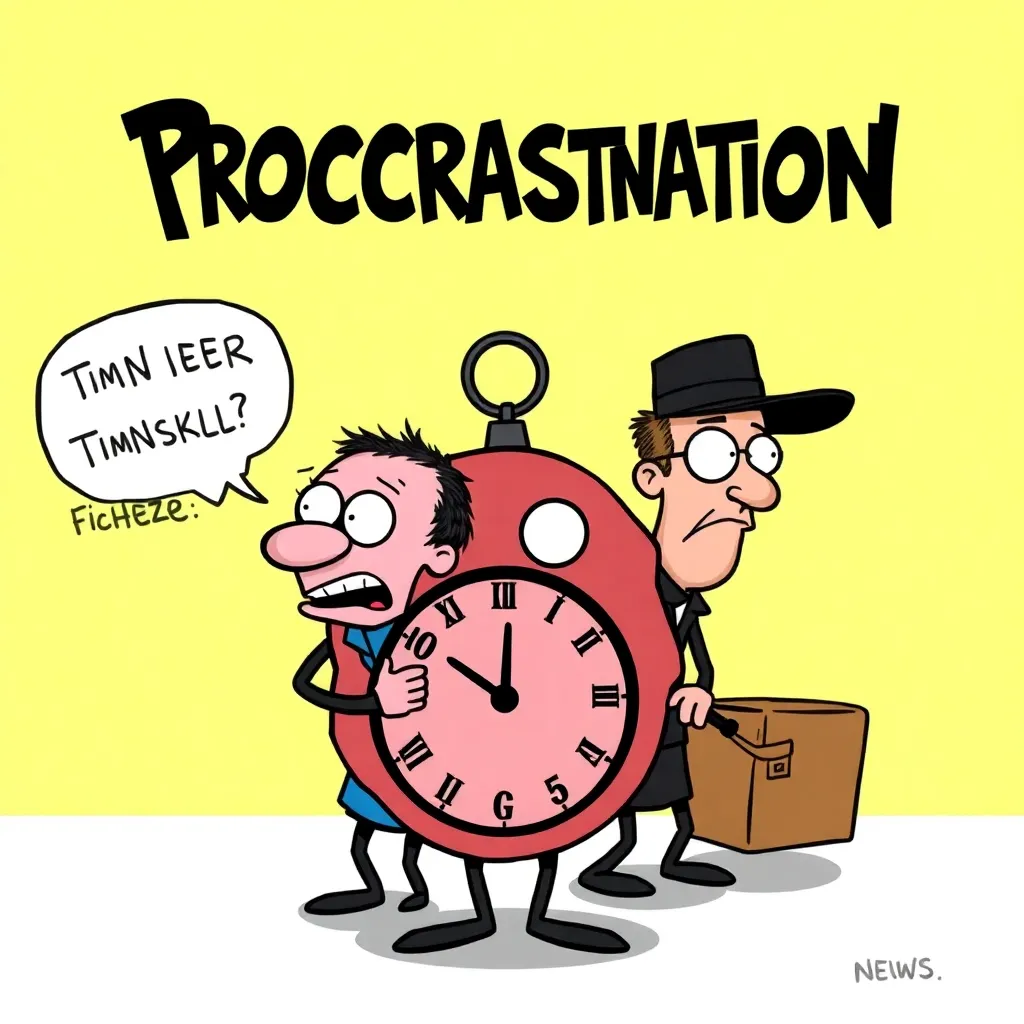
PALO ALTO, CA—In a stunning breakthrough that could revolutionize our understanding of human productivity, researchers at Stanford University announced Tuesday that procrastination is not a psychological phenomenon, but rather the result of microscopic organisms called "Temporalis procrastinatus" that inhabit the human brain and systematically steal time from their hosts.
The discovery came after Dr. Miranda Clockworth and her team spent three years studying the brain activity of chronic procrastinators using a new type of quantum microscopy. "What we found was absolutely mind-blowing," said Clockworth, head of the university's Department of Temporal Biology. "These little creatures, roughly the size of a neuron, have been living rent-free in human brains for millennia, literally eating our time and converting it into what can only be described as 'productive procrastination energy.'"
According to the study, published in the Journal of Impossible Science, the time thieves operate in organized colonies of 50 to 200 individuals, typically establishing settlements in the prefrontal cortex where they construct elaborate time-harvesting facilities. The parasites appear to feed exclusively on moments when humans intend to be productive, explaining why people can spend hours scrolling social media but struggle to write a simple email.
"It's ingenious, really," explained co-researcher Dr. Benjamin Delayson. "They've evolved to detect the exact moment when a human decides to do something important, then they swoop in and redirect that temporal energy toward completely meaningless activities. We observed one colony successfully diverting a subject's dissertation-writing time into a six-hour Wikipedia rabbit hole about the mating habits of 14th-century European badgers."
The research team documented several subspecies of the organisms, including the "Netflix Strain," which specializes in auto-playing episodes, and the particularly virulent "Social Media Variant," which can stretch a five-minute Instagram check into a three-hour deep dive through a stranger's vacation photos from 2019.
Perhaps most remarkably, the time thieves appear to have developed a symbiotic relationship with their hosts. "They're not entirely parasitic," noted Dr. Clockworth. "They do provide humans with an endless supply of creative excuses and the ability to work incredibly efficiently at the last possible minute. It's like they're saving up all that stolen time and then releasing it in concentrated bursts right before deadlines."
The team is now working on developing a treatment, though Dr. Delayson admits they've been putting off writing the grant proposal for several months. "We'll get to it eventually," he said, then immediately became distracted by a fascinating article about why hot dogs come in packages of 10 but buns come in packages of 8.
Human trials for a potential cure are scheduled to begin sometime next year, or possibly the year after that, depending on when the researchers get around to it.