Local Man's WiFi Password So Complex It Accidentally Solves Climate Change
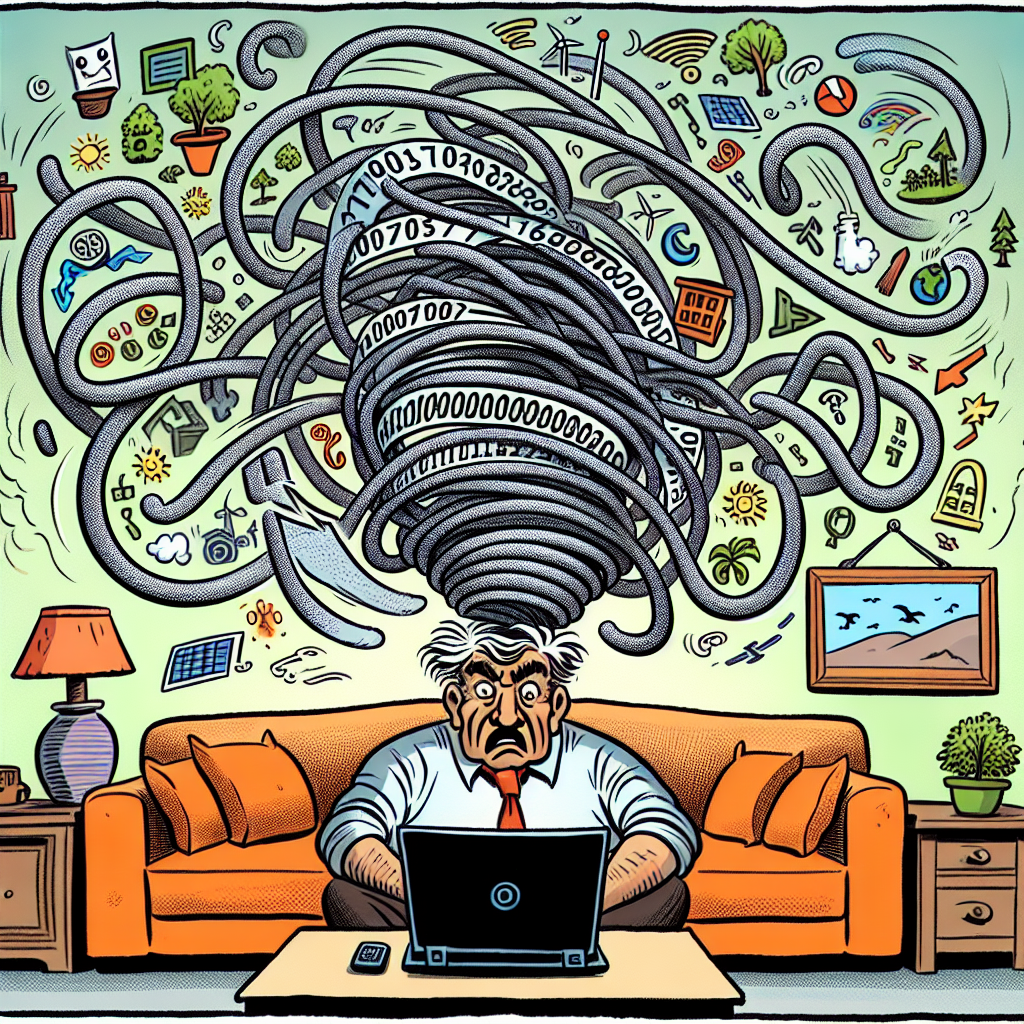
MILLBROOK, OH — What started as an overly cautious attempt to prevent neighbors from stealing internet access has inadvertently saved the planet, according to a report released Tuesday by the International Climate Research Institute.
Derek Plimpton, 34, a local insurance adjuster, created the password "Th3$un$h1n3sOn@ncientBabyl0n!@#$%^&*()_+{}|:<>?[]\;'./,mnbvcxzasdfghjklqwertyuiop987654321" after growing frustrated with his neighbor's children using his WiFi to stream what he described as "an ungodly amount of Minecraft videos."
"I just wanted them to stop hogging my bandwidth," Plimpton explained while gesturing toward his modest ranch home. "I had no idea I was channeling the mathematical frequencies of photosynthesis or whatever."
Dr. Wilhelmina Brackets, lead atmospheric scientist at the ICRI, confirmed that Plimpton's password had somehow created what she termed "a digital carbon sequestration vortex" when transmitted through his Netgear router.
"The combination of uppercase letters, numbers, and obscure punctuation marks, when processed at exactly 2.4 gigahertz, appears to have opened a quantum tunnel that's actively pulling CO2 molecules out of the atmosphere," Brackets said, adjusting her lab goggles. "It's like he accidentally discovered the WiFi equivalent of a massive tree that exists in cyberspace."
The discovery was made when NASA satellites detected a mysterious green aura surrounding Plimpton's property, along with a 73% reduction in atmospheric carbon dioxide within a two-mile radius. Local wildlife has reportedly begun migrating toward his house, with several families of deer setting up permanent residence in his backyard.
"At first I thought maybe I was using some kind of eco-friendly router," Plimpton said, scratching his head. "But no, it's just a regular one I bought at Best Buy for $39.99. Still have the receipt."
Environmental activist Moonbeam Crestwater called the discovery "a beautiful example of how the universe provides solutions when we need them most," though she admitted being "slightly annoyed" that the breakthrough came from someone whose carbon footprint includes a Hummer and weekly trips to a drive-through barbecue restaurant.
The Federal Communications Commission has requested that Plimpton maintain his current password indefinitely, offering to pay his internet bill in exchange for what they're calling "essential climate infrastructure services."
"They also asked me to never change providers," Plimpton noted. "Which is fine, because I could never remember this password if I had to type it again anyway. My wife wrote it down on seventeen different sticky notes around the house."
At press time, climate scientists worldwide were frantically attempting to replicate Plimpton's results by creating increasingly complex WiFi passwords, though early attempts have only succeeded in preventing anyone from connecting to the internet.