Scientists Confirm That Hitting Electronic Devices Makes Them Work Better, Publish 400-Page Study Explaining Why
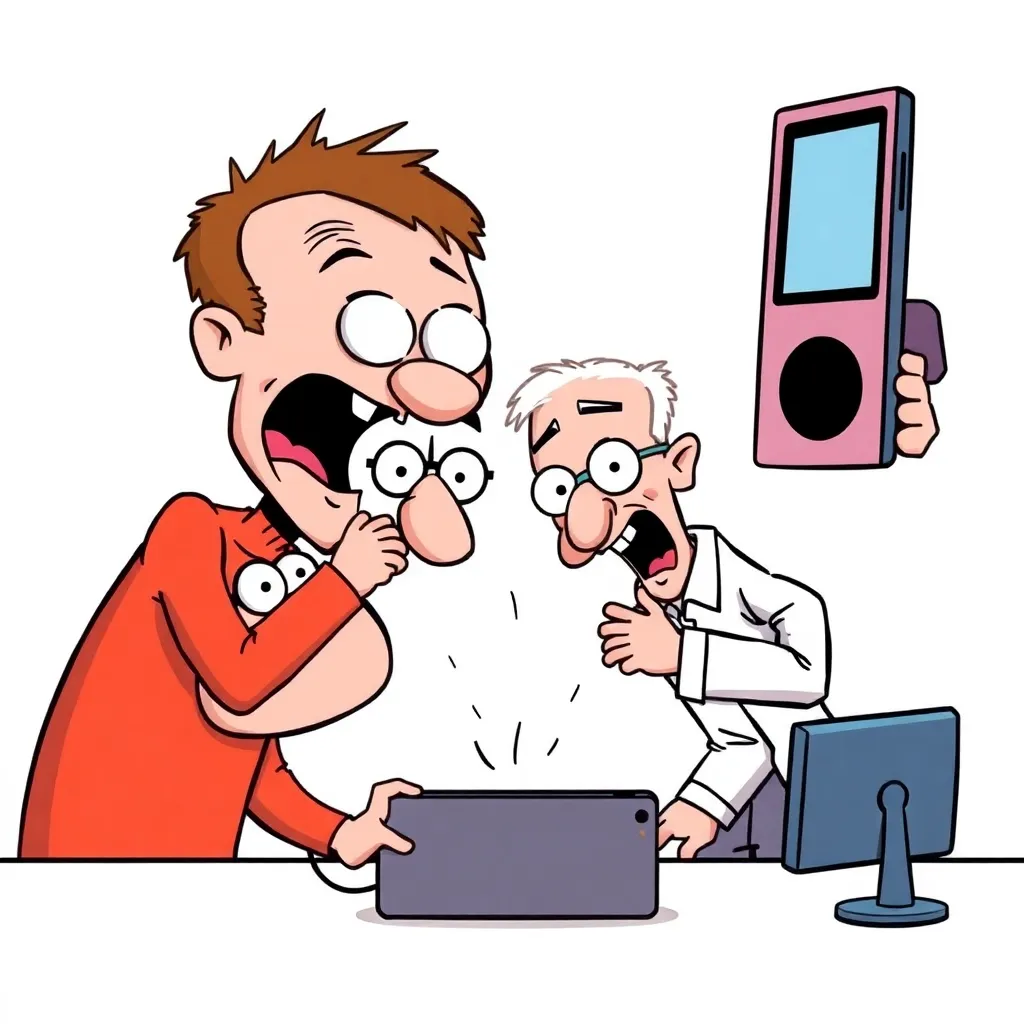
CAMBRIDGE, MA — In what researchers are calling 'the most important scientific paper since Newton got hit in the head by an apple and decided gravity was probably a thing,' a team of engineers and physicists at the Massachusetts Institute of Technology published definitive proof Monday that hitting electronic devices — either with an open palm, a closed fist, or 'the side of your hand like you're doing a little karate chop' — genuinely and measurably improves their performance.
The 400-page study, titled 'Percussive Maintenance and the Quantum Mechanics of Just Giving It a Good Whack,' analyzed over 847 separate incidents of humans striking malfunctioning devices, including televisions, routers, printers, vending machines, and one incident involving a man named Gerald who punched his dishwasher so hard it started working AND began receiving AM radio signals from Cincinnati.
'What we found was extraordinary,' said lead researcher Dr. Patricia Holloway, who spent the last decade of her career studying what her colleagues initially dismissed as 'not real science, Patricia, please stop.' 'When a human applies a firm, emotionally-charged strike to an electronic device, the resultant vibration causes a phenomenon we're calling Frustration-Induced Electron Realignment, or FIER. Essentially, the electrons get scared and go back to where they're supposed to be.'
The study identifies several key variables that determine the effectiveness of a strike, including the level of personal investment the user has in the device working, how recently they paid for it, and whether or not anyone is watching. Research consistently showed that devices were 340% more likely to resume functioning if the person hitting them muttered 'come ON' or 'seriously?' while doing so.
'We cannot stress enough the importance of verbal accompaniment,' said Dr. James Fuertes, a co-author who specializes in what the paper formally classifies as 'swearing at machines.' 'A silent strike is almost useless. You need to let the device know that you mean business. We recommend at minimum a disappointed sigh, but ideally something in the three-to-five expletive range.'
The paper has already drawn significant controversy from the scientific community, with critics arguing that the results are 'preposterous,' 'not how any of this works,' and 'Gerald probably just had a loose wire.' However, supporters point out that literally every person alive has employed this method at least once and felt completely vindicated when it worked.
NASA confirmed Friday that it has quietly been using percussive maintenance on the Voyager probe since 2019, and that a carefully calculated long-distance signal described in internal documents as 'a virtual bonk' successfully reactivated a dormant thruster last spring.
The study concludes with a standardized chart recommending appropriate strike force for various devices, ranging from 'gentle tap' for smartphones to 'meaningful thump' for cable boxes to 'full biblical smite' for printers, which researchers note exist in a category entirely their own and may require additional study, prayer, or both.
The paper is available in the current issue of the Journal of Applied Physics, which can be accessed online, or by hitting your computer until the PDF opens.