Scientists Discover Procrastination Actually Time Travel, Explain Why Deadlines Keep Getting Closer
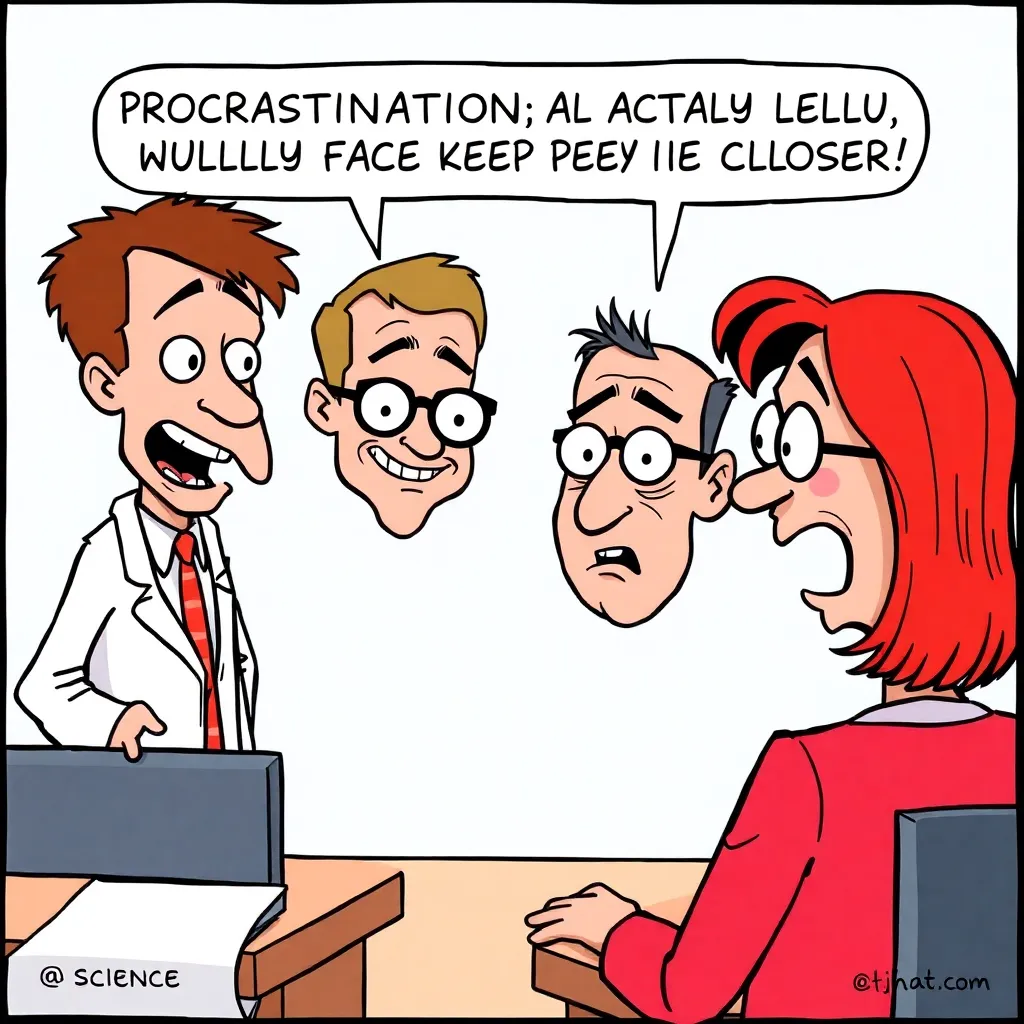
CAMBRIDGE, MA — In a discovery that finally validates the lived experience of millions of college students and office workers worldwide, researchers at the Massachusetts Institute of Technology announced Tuesday that procrastination has been definitively proven to be a form of localized time travel that causes deadlines to approach at an exponentially accelerated rate.
The study, published in the Journal of Temporal Dynamics and Poor Life Choices, utilized advanced chronometer arrays to measure time distortion fields around subjects engaged in various procrastination activities. Lead researcher Dr. Margaret Postpone found that individuals watching Netflix instead of working on important projects generated what she termed "chronological acceleration zones" extending up to 15 feet in all directions.
"What we're seeing is absolutely remarkable," said Dr. Postpone, who notably submitted her research findings 47 minutes past the journal's deadline. "When subjects engage in procrastination behaviors—scrolling social media, reorganizing their sock drawer, suddenly deciding to deep-clean their bathroom grout—they create temporal anomalies that cause time to move 300% faster specifically around their pending responsibilities."
The research team monitored 500 volunteers over six months, equipping them with precision timepieces and assigning various tasks with firm deadlines. Subjects who immediately began working experienced normal time flow, with their deadlines approaching at the expected rate of one day per day. However, procrastinating subjects reported that weeks would mysteriously compress into hours, with assignments due "next month" suddenly becoming due "tomorrow" without explanation.
"It's like the universe is conspiring against me," said study participant Jennifer Martinez, 23, who swears she was assigned a term paper "literally yesterday" despite university records showing she received the assignment eight weeks ago. "I'll look at the calendar on Monday and see I have plenty of time, then somehow it's Thursday night and I'm crying into a bag of chips while typing frantically."
Dr. Postpone's team also discovered that certain procrastination activities generate more severe temporal distortions than others. Binge-watching TV shows creates moderate time acceleration, while organizing computer files or suddenly developing an intense interest in learning obscure historical facts can compress entire weeks into what feels like minutes.
"The data clearly shows that the closer a deadline gets, the more rapidly procrastination accelerates time," explained co-researcher Dr. Timothy Delay. "We've documented cases where subjects lost entire weekends in what they perceived as single afternoon Netflix sessions."
The findings have prompted calls for procrastination to be officially classified as an extreme sport, given its apparent ability to manipulate the fundamental fabric of spacetime. The research team plans to continue their investigation, though they admit they keep putting off writing their follow-up grant proposals.
"We'll definitely start working on the next phase soon," Dr. Postpone assured reporters. "Just as soon as we finish reorganizing our lab equipment. And maybe clean out our email inboxes. Actually, did anyone else know that penguins can't taste fish? We should probably research that first."