Scientists Discover That Procrastination Actually Creates Additional Time Through Quantum Mechanics
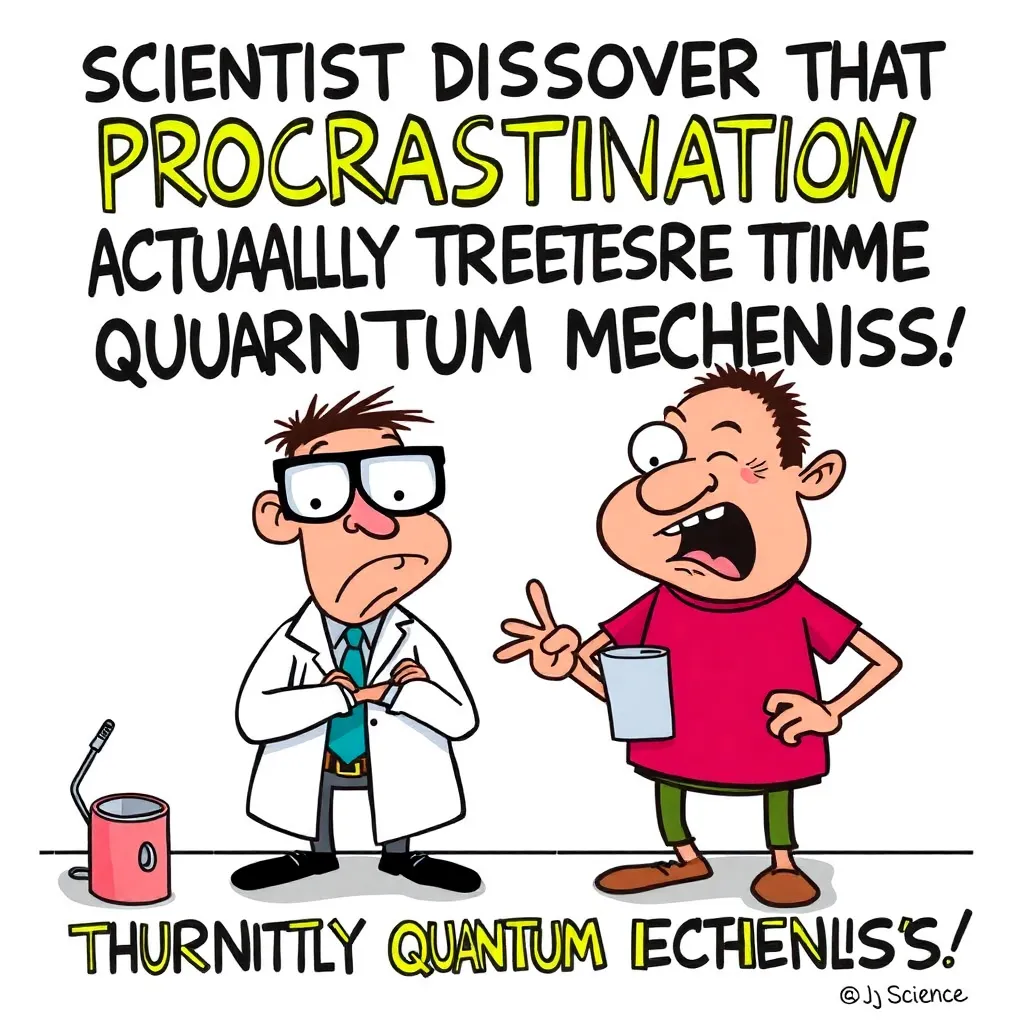
CAMBRIDGE, MA—In a discovery that could revolutionize our understanding of time management and fundamental physics, researchers at MIT announced Tuesday that chronic procrastination actually creates additional time through previously unknown quantum mechanical processes.
The study, published in the Journal of Temporal Displacement and Really Bad Habits, found that individuals who consistently delay important tasks generate what scientists are calling "stress-induced chronotons"—subatomic particles that accumulate in small pockets around procrastinators, effectively slowing down time in their immediate vicinity.
"We always suspected something was up when procrastinators kept insisting they had 'plenty of time' despite overwhelming evidence to the contrary," said lead researcher Dr. Miranda Postpone, who ironically submitted her findings three months after the original deadline. "It turns out they were technically correct. The universe literally bends spacetime to accommodate their poor planning."
The research team studied 847 chronic procrastinators over two years, measuring temporal fluctuations around subjects as they approached various deadlines. Using highly sensitive quantum chronometers, scientists detected measurable time dilation effects averaging 0.003 seconds per hour of delayed work.
"The effect is most pronounced during what we call 'panic phases,'" explained co-researcher Dr. Ben Stalling. "When subjects reach peak stress levels—typically 15 minutes before a major deadline—they generate enough chronotons to create temporal bubbles lasting up to 3.7 additional seconds. It's not much, but it's measurably real."
The findings help explain numerous previously puzzling phenomena, including how college students consistently turn in assignments exactly at midnight despite starting them at 11:47 PM, and why people running late for flights somehow always make it to the gate just as boarding begins.
"This research validates what procrastinators have known intuitively for millennia," said Dr. Iwanna Waitmore, director of the Institute for Advanced Deadline Studies. "They're not just lucky—they're unconsciously manipulating the fabric of reality itself."
However, the team warns against attempting to exploit this quantum procrastination effect deliberately. "Conscious efforts to procrastinate for temporal gain appear to neutralize the chronoton generation process," noted Dr. Postpone. "The time dilation only works when the procrastination is genuine, anxiety-inducing, and completely inadvisable."
The research has already attracted attention from NASA, which is exploring whether chronic procrastinators might serve as natural time-dilution engines for long-distance space travel. "We're looking at recruiting people who've never filed their taxes on time," confirmed agency spokesperson Janet Cosmic. "Their temporal manipulation abilities could be exactly what we need for Mars missions."
At press time, Dr. Postpone was reportedly three weeks behind on her follow-up study about the quantum mechanics of hitting the snooze button, though she insisted she still had "tons of time" to complete it.