Scientists Discover That Procrastination Is Actually A Time-Dilating Superpower That Slows Down Deadlines
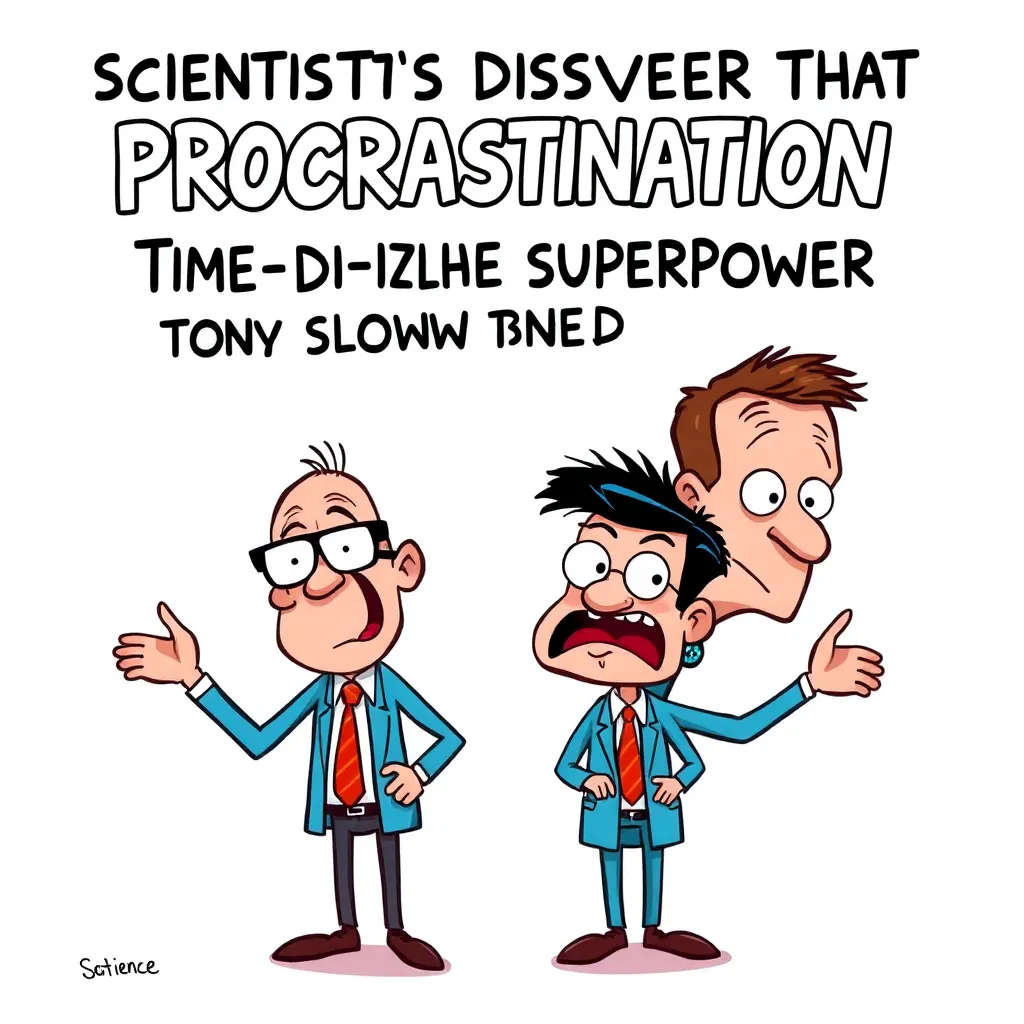
CAMBRIDGE, MA—In a discovery that could revolutionize our understanding of both productivity and theoretical physics, researchers at the Institute for Temporal Behavioral Studies announced Tuesday that procrastination is actually a previously unknown superpower that allows individuals to slow down the passage of time around approaching deadlines.
The study, led by Dr. Margaret Postpone, monitored 500 chronic procrastinators over the course of six months—or what researchers calculated to be approximately 14 years in "procrastinator time." Using advanced chronometers and deadline-detection equipment, the team observed that subjects consistently experienced a measurable dilation effect, with deadlines approaching up to 73% slower than normal temporal flow.
"We always assumed procrastinators were just poor at time management," said Dr. Postpone, who notably submitted her research findings three years after the original deadline. "It turns out they've been unconsciously bending the fabric of reality itself. When someone says 'I work better under pressure,' they're literally creating a pocket dimension where pressure takes longer to build."
The research team documented numerous instances of what they term "temporal stretching," including one subject who experienced a 48-hour deadline extension that occurred entirely within the final hour before submission. Another participant reportedly wrote a 20-page research paper in what felt like 30 minutes, though outside observers noted the process took 17 hours.
Dr. Raymond Eventually, a quantum physicist at Princeton who was not involved in the study, expressed skepticism about the findings. "This is either groundbreaking science or complete nonsense," Eventually stated. "I've been meaning to review their methodology for the past eight months, but somehow I keep running out of time."
The discovery has sparked intense debate within the scientific community, with many researchers suddenly finding themselves unable to meet their own deadlines as they attempt to harness procrastination-based time manipulation for their own work.
"The implications are staggering," noted theoretical physicist Dr. Lisa Laterston, speaking from her office where she has been 'about to start' analyzing the data for the past six weeks. "If we can understand and control this phenomenon, we could solve humanity's greatest temporal challenges. I'll definitely look into it more tomorrow."
The research team plans to continue their investigation, though they acknowledge the next phase of the study has been postponed indefinitely. "We're hoping to publish our follow-up findings next month," Dr. Postpone explained, "or possibly next year. Time will tell—assuming it doesn't slow down again."