UN Summit Ends In Chaos After World Leaders Discover They Have All Been Accidentally Attending The Wrong Meeting For 11 Years
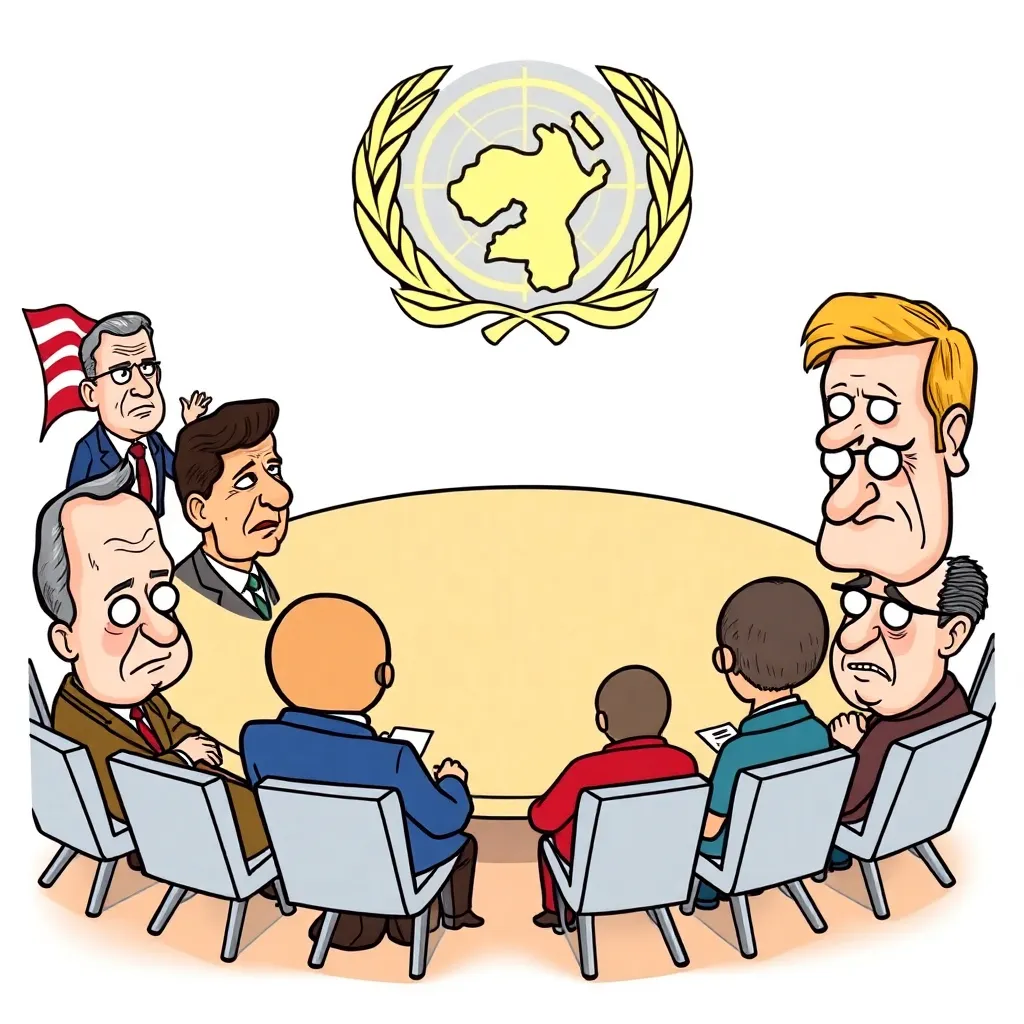
GENEVA — In what diplomatic historians are already calling 'the most significant clerical error since someone accidentally declared war on the wrong Portugal,' world leaders from 194 nations were left visibly shaken Tuesday after discovering that the high-stakes international summits they have faithfully attended since 2013 were, in fact, a biweekly meeting of the Bruges East Rotary Club, a volunteer civic organization with 34 members and a very accommodating event space.
The error was discovered when French President Emmanuel Macron attempted to ratify a landmark carbon emissions treaty and was interrupted by Rotary Club secretary Hendrik Voss, 67, who informed him that the agenda item for 3 PM was actually 'updates on the bake sale fundraiser for the Bruges Municipal Duck Pond Restoration Project.'
'I just assumed the duck pond was a metaphor,' said a visibly shaken German Chancellor Olaf Scholz, clutching a laminated name badge that read 'GUEST — PLEASE SIGN IN AT THE FRONT DESK.' 'A very powerful, geopolitical metaphor. I gave a forty-minute speech about it in 2019.'
Perhaps most alarming to officials was the revelation that the actual UN General Assembly, operating without the presence of any world leaders for over a decade, had been running with remarkable efficiency. According to internal documents, the assembly passed 847 binding international resolutions, established a framework for global renewable energy transition, solved three regional conflicts, and implemented a universal standard for electrical outlet sizes, a problem that had eluded diplomats for sixty years.
'Honestly, it's been really productive,' said UN Under-Secretary for Administrative Affairs Carol Timmins, who admitted she had simply 'stopped sending reminder emails after the first year.' 'We got so much done. The snack budget alone improved by 340 percent.'
Political scientists are now scrambling to assess the geopolitical implications. Dr. Patricia Osei of the London School of Economics called the situation 'unprecedented but also, in hindsight, quite explainable,' noting that the Bruges Rotary Club's meeting minutes bore a striking resemblance to UN communiqués, primarily because both documents consisted mostly of vague language and promises to 'follow up on this at the next meeting.'
'The Rotary Club did, in fairness, successfully coordinate a very nice holiday card exchange between member nations,' Dr. Osei noted. 'The one from Japan had a pop-up crane. Genuinely lovely.'
Rotary Club President Marta Van den Berg, 71, said she had suspected something was off when Vladimir Putin showed up in 2016 and spent forty-five minutes arguing about seating arrangements, but ultimately chalked it up to 'some people just being very passionate about community service.'
'He did volunteer for the canned food drive,' Van den Berg confirmed. 'Showed up with an absolutely extraordinary number of cans. We didn't ask questions.'
As of press time, world leaders had agreed to hold an emergency session to address the situation, which they scheduled for next Tuesday at the Bruges East Rotary Club meeting hall, as it was 'the only venue they knew how to get to.'