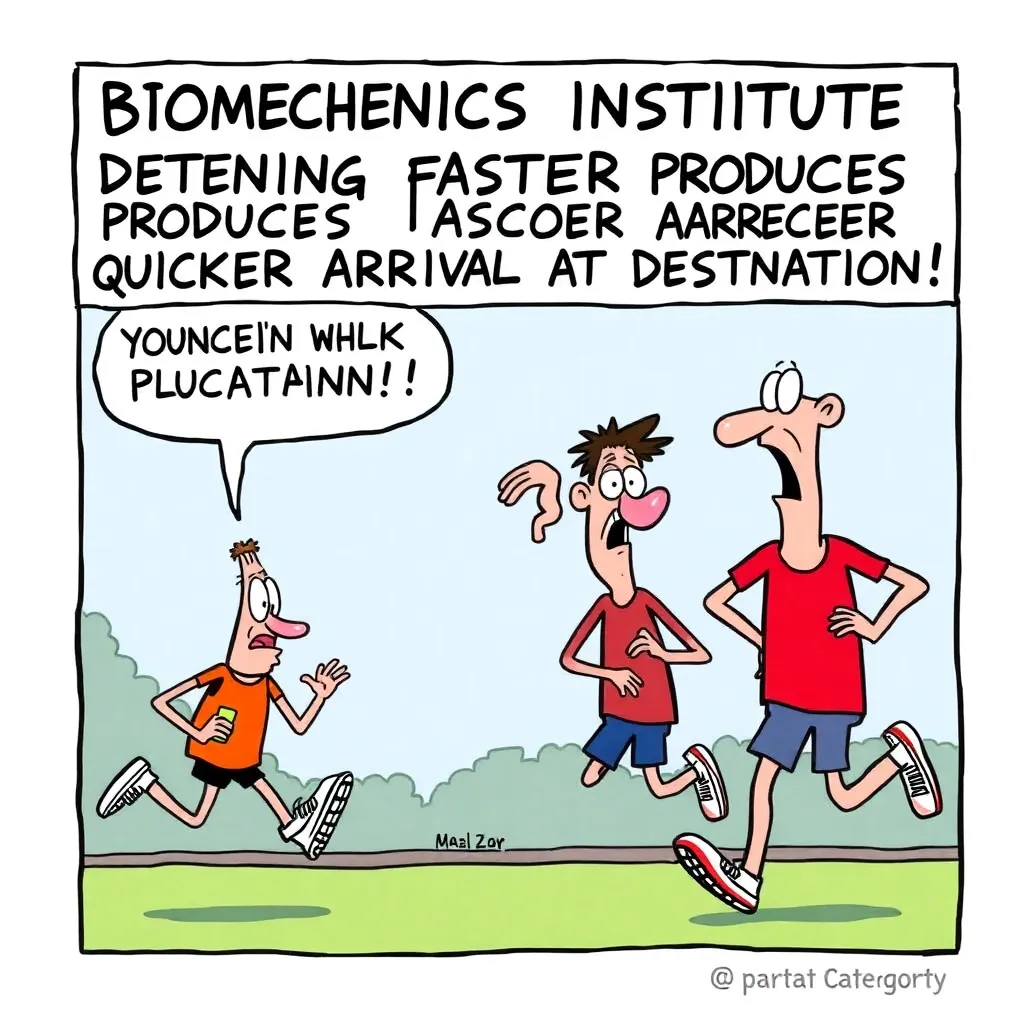
Biomechanics Institute Determines Running Faster Produces Quicker Arrival At Destination, Coaches Asked To Review Implications For Strategy
COLUMBUS, OH — After four years of federally funded research, a nine-university coalition operating under the Sports Science Consortium of Greater North America has published what it describes as a 'foundational contribution to athletic epistemology': a 340-page peer-reviewed report confirming that, when a football is thrown, the catching of said football represents the intended and desirable conclusion of the throw.
The report, titled 'Projectile-To-Reception Continuity in Organized Gridiron Contexts: A Framework for Understanding What Is Supposed to Happen Next,' was released Thursday morning at a press conference attended by seventeen researchers, four graduate students operating a single shared laser pointer, and one sports journalist who left during the abstract.
'What we found, and I want to be precise here, is that the throw and the catch are related,' said Dr. Pamela Forthright, lead author and Associate Professor of Applied Ball Dynamics at Ohio State. 'Causally related. In sequence. The throw comes first. Then, if all goes well, the catch. We're calling this the Throw-Catch Continuum, and we believe it has significant implications for how teams approach the forward pass.'
The study drew on 12,000 hours of game footage, 847 player interviews, and what the report describes as 'an extensive qualitative review of the ball itself.' Researchers used high-speed cameras, motion capture suits, and a proprietary metric called the Reception Likelihood Anticipation Probability Score, or RLAPS, which measures how likely it is that a thrown ball will be caught on a scale of zero to 'yes.'
'We were surprised by some of our findings,' admitted Dr. Gerald Tuft, co-author and Director of the Center for Outcome-Oriented Sporting Phenomena. 'Early in the study, we hypothesized that the ball might sometimes prefer not to be caught. The data did not support this. The ball, it turns out, has no preference. That was a real moment for our team.'
The NFL Players Association has responded cautiously, issuing a two-sentence statement acknowledging receipt of the report and noting that players 'have been aware of catching for some time.' The league office declined to comment but confirmed it has commissioned a separate $2.3 million study to determine whether touchdowns continue to occur in the end zone or whether that arrangement has 'evolved.'
Not everyone is convinced the findings warrant celebration. Dr. Sylvia Crenshaw, a sports kinesiologist at Michigan who was not involved in the research, called the report 'thorough, well-formatted, and almost aggressively obvious.'
'They spent four years,' she said slowly. 'Four years. To confirm that catching is the thing that happens after throwing. My nephew figured this out in a park. He was four. He cried when he dropped it, which tells me he already understood the goal.'
Dr. Forthright pushed back on such criticism during the press conference, arguing that documenting the obvious is itself a scientific act. 'Every generation must re-verify what it knows,' she said. 'That is the covenant of empiricism. Also, the grant was non-refundable.'
The Consortium has announced a follow-up study examining whether running with the ball after catching it is, as currently theorized, better than stopping.