Curtain Call Task Force Releases Interim Guidance Confirming Curtain Went Down And Then Came Back Up, Describes Sequence As 'Broadly Expected But Worth Documenting'
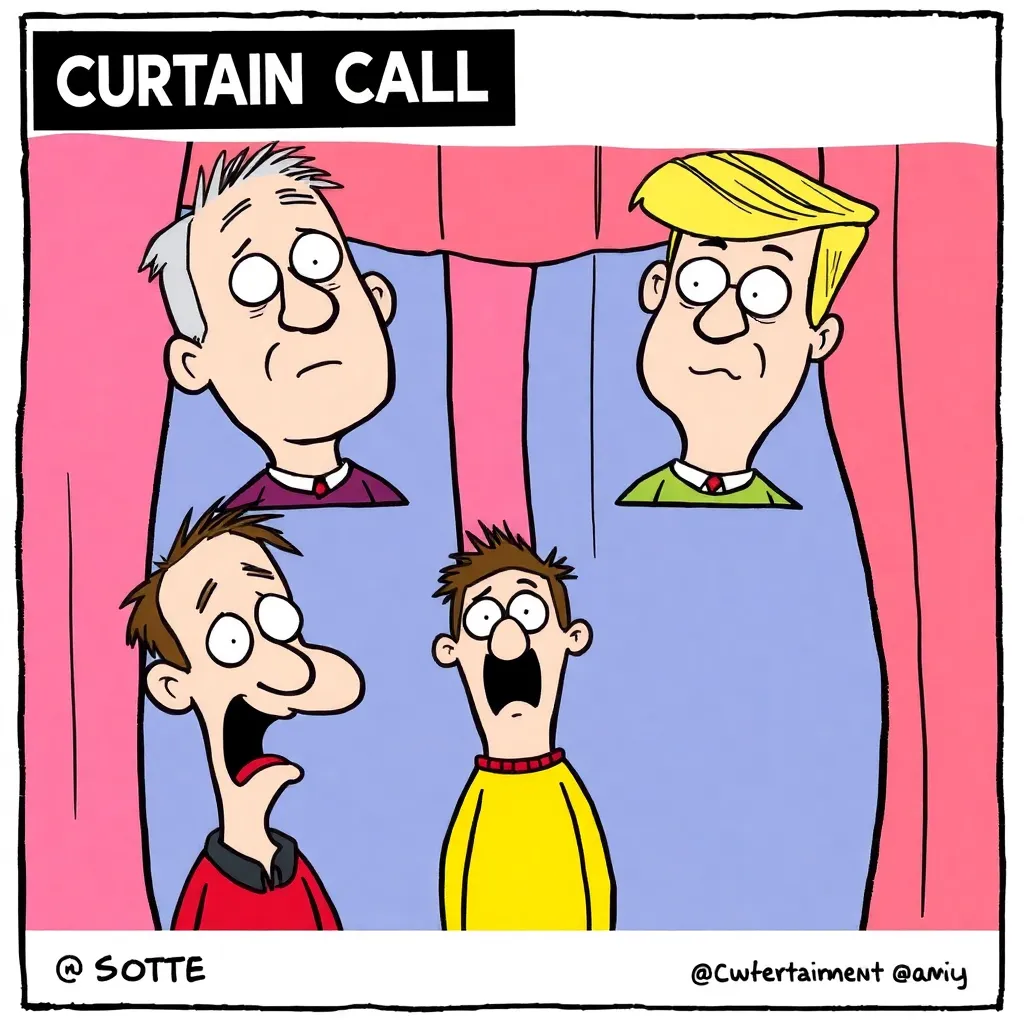
WASHINGTON — The National Entertainment Engagement and Applause Monitoring Bureau (NEEAMB) issued a sweeping policy briefing Tuesday confirming that applause, the rhythmic striking together of two human palms, constitutes a form of sound that originates from audiences seated in venues, and not from the performers themselves, though officials were careful to note that no formal determination has yet been made regarding performers who are also seated.
The briefing, which spans 280 pages and includes seventeen appendices, fourteen of which are labeled 'Supplemental Appendix A,' was described by acting bureau director Claudette Ferns as 'the most comprehensive federal acknowledgment of audience-generated noise to date.'
'What we can say with confidence,' Ferns told reporters at a press conference held in a medium-sized room, 'is that applause happens after the performance concludes, or sometimes during, and that it is produced by people who are there. Whether those people intended to applaud or simply found themselves doing so remains outside the current scope of this briefing.'
The report, which cost an estimated $4.3 million to produce and was funded through a grant originally earmarked for rural ventilation studies, has drawn both praise and confusion from the entertainment industry.
'This is the clarification we didn't know we needed and still aren't sure we needed,' said Dr. Phillip Oates, Senior Fellow of Audience Behavior at the Center for Crowd-Adjacent Research. 'The data strongly suggests that when audiences clap, a sound occurs. We've modeled several scenarios in which they don't clap, and in those scenarios, the sound does not occur. That finding alone justifies the appendices.'
The briefing stops short of advising performers on how to emotionally respond to applause, noting that 'the affective dimension of clapping reception falls under the jurisdiction of a separate interagency working group currently in the process of scheduling its first meeting.'
Local officials in at least three municipalities issued statements Wednesday clarifying that they had read the briefing's executive summary and had no further comment at this time, but wanted residents to know they were aware the briefing existed.
'We are aware the briefing exists,' said one local official, who asked to remain unquoted.
Critics of the report argue it fails to address a central ambiguity: whether a standing ovation in which some audience members remain seated due to back pain constitutes a full standing ovation, a partial standing ovation, or what the briefing terms a 'mixed-vertical engagement scenario,' a phrase that appears 41 times in the document without a formal definition.
'We flagged the mixed-vertical issue early,' said Dr. Oates. 'We flagged it in the draft, we flagged it in the revised draft, and we flagged it again at a dinner no one else attended. At a certain point, a flag is just a flag.'
The bureau says a follow-up briefing addressing whether silence after a performance constitutes the absence of applause, or something else entirely, is expected to be released within 18 to 24 months, pending budget approval and the resolution of an internal dispute over font size.
Ticket holders are advised to continue attending performances in the meantime.