International Gravity Research Consortium Confirms Objects Released From Hand Subsequently Travel Downward, Calls Trajectory 'Statistically Dominant But Not Without Nuance'
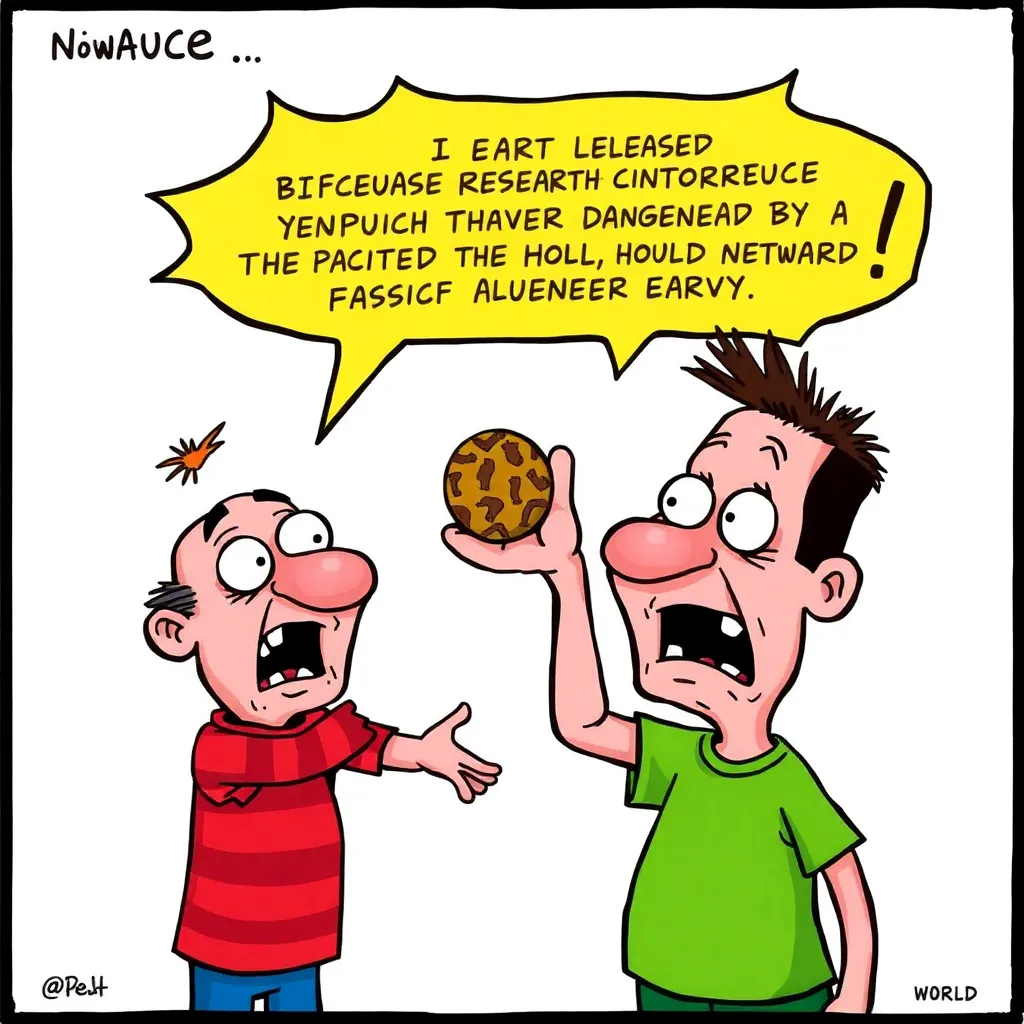
GENEVA — In what is being described as a 'watershed moment for physics-adjacent inquiry,' the International Gravity Research Consortium (IGRC) released its long-awaited 1,200-page findings Tuesday, formally confirming that objects released from the human hand will, under most observable conditions, travel in a downward direction.
The study, which spanned 14 countries, involved 340 lead researchers, and consumed an estimated $240 million in multinational grant funding, concluded that gravity's influence on handheld objects is 'pervasive, recurring, and directionally consistent in a majority of documented trials.'
'We didn't want to rush this,' said Dr. Pieter Vanderholm, the consortium's Director of Descent Analytics and lead author of the report. 'Extraordinary claims require extraordinary evidence, and the claim that a pen dropped in Zurich will behave similarly to a pen dropped in Nairobi is, frankly, extraordinary. We felt the scientific community deserved rigor.'
The study involved dropping 4.7 million objects of varying shapes, densities, and emotional significance across controlled laboratory environments, open fields, parking structures, and what the report describes as 'one moderately windy boat.' Researchers meticulously logged each drop using high-speed cameras, seismic sensors, and, in the early phases of the study, a graduate student named Trevor who was later replaced by 'more reliable instrumentation.'
Of the 4.7 million drops, approximately 94% resulted in the object moving downward. The remaining 6% were classified as 'anomalous,' 'balloon-related,' or 'Trevor incidents' and will be the subject of a follow-up paper expected in 2029.
'The 6% is where the real science is,' said Dr. Amara Osei-Bonsu, a senior fellow at the Basel Institute for Things Falling, who was not involved in the study but called its findings 'largely expected, which is exactly why they needed to be confirmed.' 'We cannot simply assume that 94% tells the whole story. What is the other 6% trying to communicate? That question deserves at minimum another decade of inquiry and a separate budget line.'
The report has been met with enthusiasm by the broader scientific community, though several peer reviewers noted that the executive summary — which reads, in its entirety, 'Stuff goes down' — may have 'undersold the complexity of the methodology.'
In response, the IGRC released a supplemental 47-page addendum clarifying that 'down' is a directional concept relative to the gravitational body nearest the object at time of release, and cautioning readers not to generalize the findings to the Moon 'without consulting the appropriate regional gravity authorities.'
World leaders have reportedly been briefed. The European Commission issued a statement calling the findings 'a foundation upon which further foundations may be built.' The United Nations has convened an emergency subcommittee to assess whether the results require updating of any international treaties that may implicitly assume objects go sideways.
Dr. Vanderholm, when asked what he hopes people take away from seven years of work, paused for a long moment before answering.
'Humility,' he said. 'And also: let go of something and watch it. Really watch it. We finally have the data to confirm what you are seeing is real.'
The full report is available for download in PDF format. It is 1,200 pages. The object you are holding to read this will, upon release, go down.