Landmark Study Determines Politicians Who Have Stopped Talking Are Not Currently Talking, Coalition Calls Findings 'Politically Sensitive But Geometrically Sound'
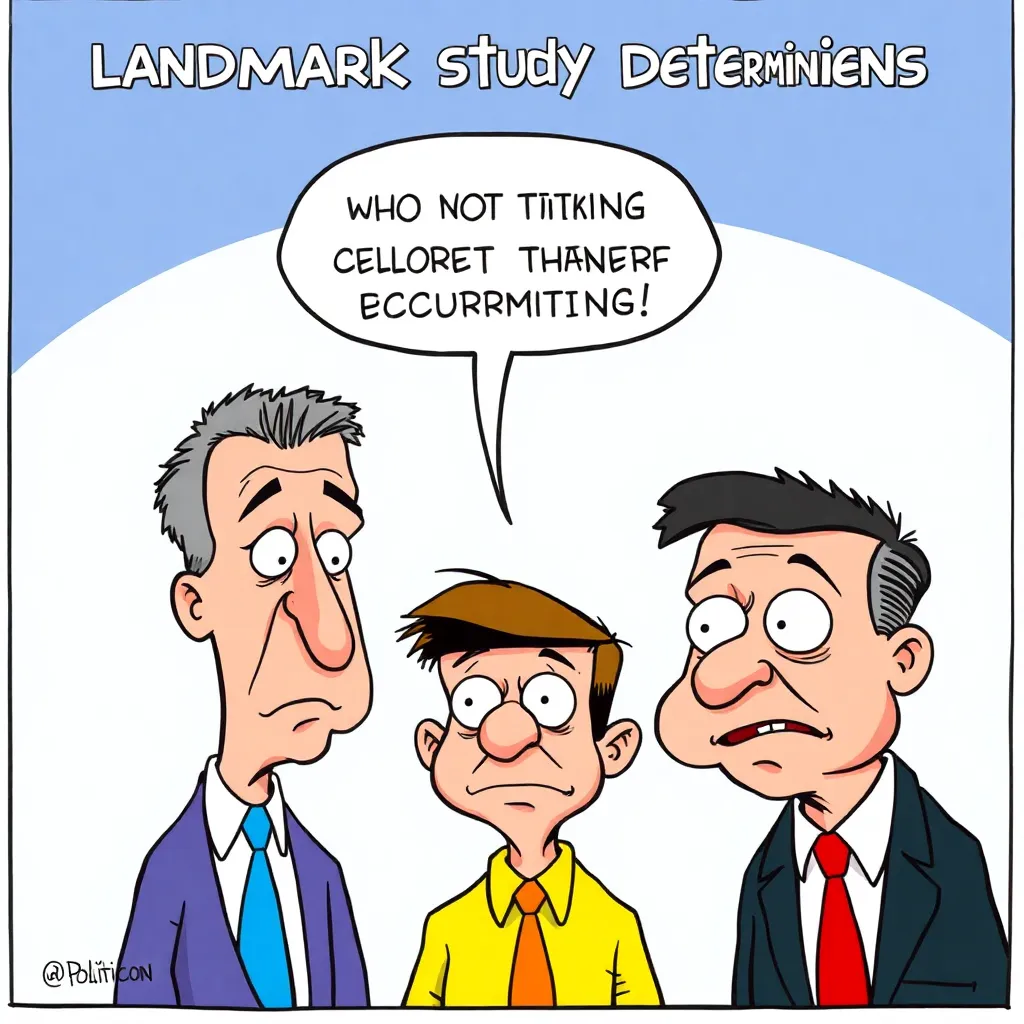
WASHINGTON, D.C. — The National Consortium for Legislative Positional Awareness (NCLPA) issued a sweeping public safety alert Thursday following the release of a landmark 614-page scientific report confirming that members of the United States Senate who are observed sitting in their chairs are, during that period, in a condition best described as 'sitting.'
The study, which took approximately four years and $38 million in federal funding to complete, drew on thermal imaging, eyewitness testimony from C-SPAN camera operators, and a proprietary 'Chair Occupancy Index' developed exclusively for this research. Findings were described by the lead authors as 'robust, replicable, and something we probably should have considered wrapping up sooner.'
'What we can say with confidence,' said Dr. Marlene Goff, Senior Fellow of Legislative Geometry at the Institute for Governmental Posture Studies, 'is that a senator in a chair is not standing. We want to be very careful not to overstate that, but we also feel the public deserves to know.'
The alert, distributed to all fifty states and three territories, advises citizens to 'take a moment' before approaching any conclusion about the ambulatory status of elected officials without first consulting available seating data. A supplemental guidance document recommends that gallery visitors 'breathe normally' upon observing a senator transition between sitting and not sitting, and notes that such transitions, while not unprecedented, remain 'an area requiring ongoing observation.'
Senate Majority Whip offices were briefed on the findings late Wednesday evening. A spokesperson confirmed that leadership had reviewed the executive summary and found the conclusions 'broadly consistent with what several staffers had suspected for some time but felt unqualified to assert publicly.'
Critics have raised concerns about the scope of the research. Dr. Tobias Wrench, a dissident posture analyst and author of the self-published monograph 'Are They Sitting Though: A Skeptic's Guide,' warned that the study failed to account for 'the ambiguous transitional phase between lowering and full contact with the chair surface,' which he described as 'a gray zone that this report has, frankly, glossed over with a confidence I find troubling.'
The NCLPA acknowledged the limitation in a footnote spanning eleven pages.
Public response has been mixed. A constituent in Akron, Ohio, told reporters she found the alert 'helpful but also not helpful.' A retired postal worker in Flagstaff said he had 'always kind of assumed they were sitting, but it's nice to have the paperwork.' At least one senator, whose name was withheld pending a separate review, reportedly stood up upon hearing the findings, which researchers noted would require a brief amendment to the final report.
A follow-up study is already underway examining whether senators who are not currently speaking have, in fact, stopped speaking, with preliminary results expected sometime before the next administration, 'barring unforeseen methodological chair-related complications,' according to a spokesperson for the Consortium.
Citizens are advised to remain calm, stay informed, and, if they observe a senator in a chair, to document it only if they feel emotionally prepared to do so.