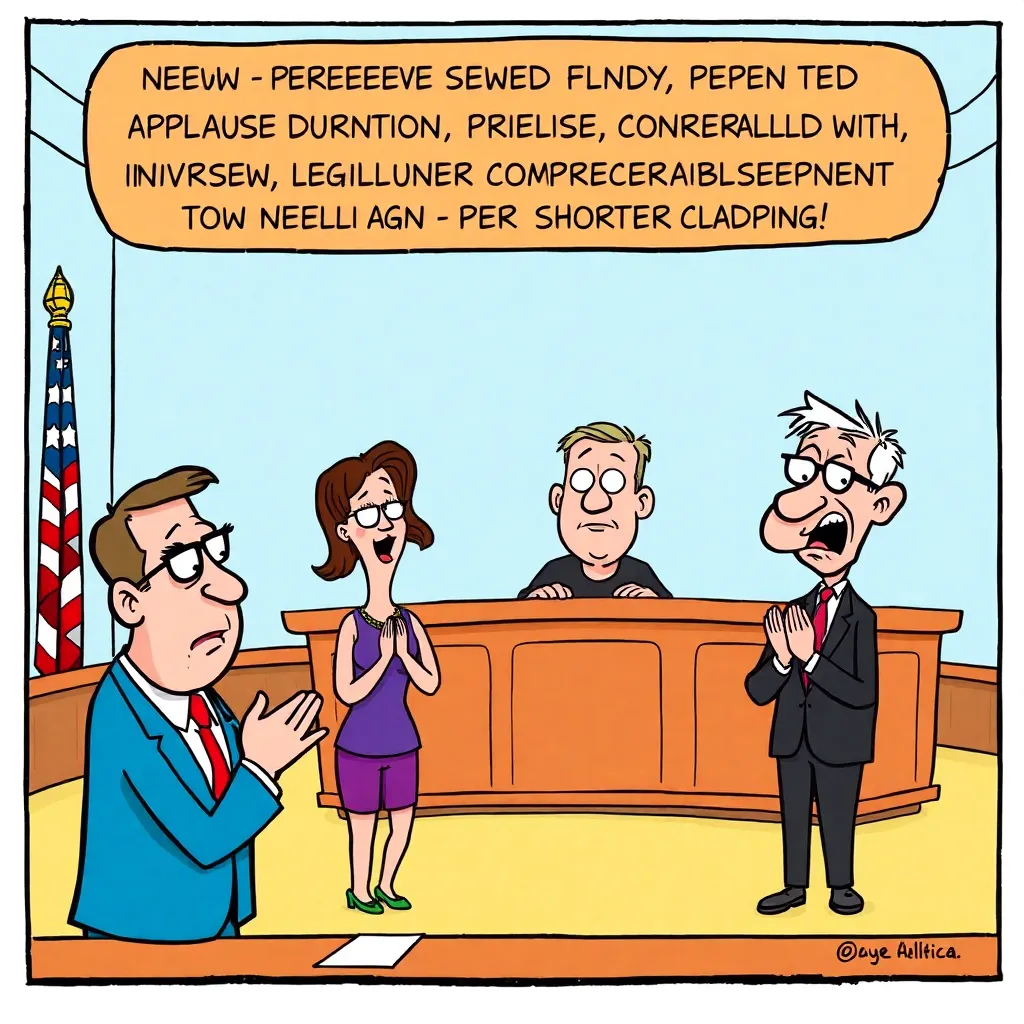
New Peer-Reviewed Study Finds Applause Duration In House Chamber Inversely Correlated With Legislative Comprehension, Panel Urges Shorter Clapping
WASHINGTON, D.C. — The National Institutes of Health released findings Tuesday from a three-year longitudinal study concluding that United States senators who position themselves within six feet of a buffet table during legislative receptions retain approximately 40% less policy information than colleagues who remain seated, a discovery officials are calling 'urgent, reproducible, and deeply unsurprising.'
The study, which tracked 87 senators across 214 catered government events using a combination of eye-tracking software and what researchers described only as 'discreet clipboard observation,' found a statistically significant correlation between proximity to chafing dishes and a measurable decline in the ability to recall bill numbers, amendment details, and 'the general thrust of why they attended the event in the first place.'
'We controlled for shrimp cocktail, we controlled for carving stations, we even ran a separate regression on the presence of those little crab-stuffed mushrooms,' said Dr. Pamela Grieff, lead researcher and Director of the NIH's newly established Division of Legislative Cognitive Environments. 'The buffet effect held across all variables. It is, scientifically speaking, the zone of not knowing things.'
The Surgeon General's office responded swiftly, issuing a Level 2 Public Safety Guidance Bulletin — defined in federal code as 'elevated concern, non-mandatory, laminated if possible' — advising all event coordinators at federal functions to position senators no closer than eight feet from any catering surface, with an additional two-foot buffer recommended near anything described on the menu as 'a station.'
'We are not saying senators cannot eat,' the bulletin reads. 'We are saying they should do so deliberately, in chairs, away from pending legislation.'
Several sitting senators disputed the findings, though none of them, when contacted for comment, could immediately recall which committee they served on.
'I've eaten standing up at these events for twenty-two years and I have always known exactly what's going on,' said Senator Dale Forthwright (R-OH), who then asked a nearby aide what state he represented. 'The point is, this is government overreach into the catering space, which I believe is still protected.'
The study has drawn both praise and concern from the scientific community. Dr. Yolanda Fitch of the Brookings Institution called the findings 'a paradigm shift in how we understand the legislative digestive-cognitive interface,' while Dr. Marcus Truell of Georgetown's School of Public Policy noted that the research 'raises profound questions about every infrastructure bill passed within fifteen feet of a shrimp ring.'
The White House has not yet commented, though sources indicate the Chief of Staff has quietly requested that the State Dinner seating chart be reviewed 'with some urgency.'
The full report, titled 'Buffet Adjacency and the Erosion of Deliberative Capacity in Elected Officials: A Field Study,' is available on the NIH website and is, per the researchers' request, not to be read while standing.