OFFICIAL STATEMENT FROM THE DEPARTMENT OF NONSENSE: Federal Atmospheric Moisture Precipitation Continuity Bureau Releases 612-Page Compliance Report Confirming That Rain Which Fell From The Sky Did So In A Downward Direction Onto Things That Were Below It, Precipitation Analysts Describe Event As 'Wet, Ceiling-Originated, And Affecting Surfaces In The Impact Zone'
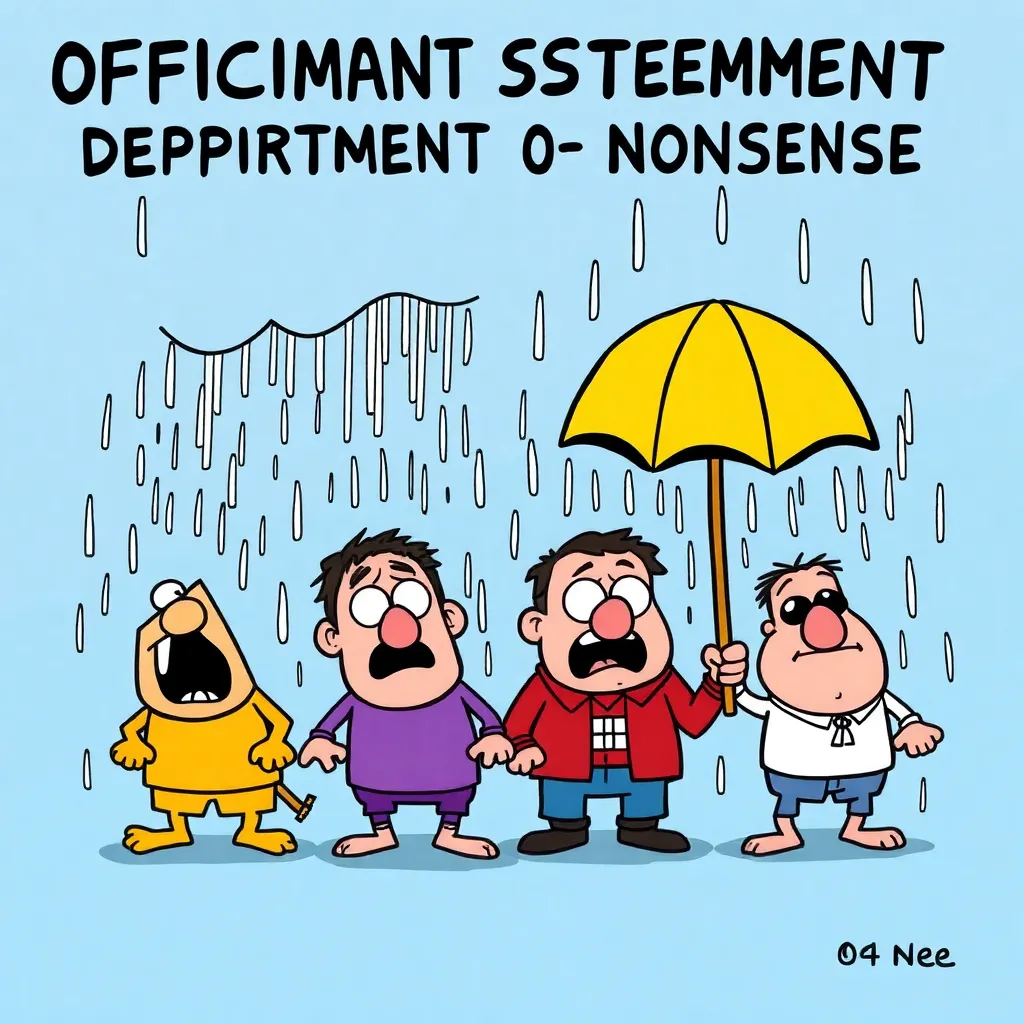
WASHINGTON, D.C. — The Federal Atmospheric Moisture Precipitation Continuity Bureau (FAMPCB), a sub-division of the Office of Sky-Related Outcomes within the Department of Nonsense, released its annual 612-page compliance report Thursday morning formally establishing that rain observed over a 14-county region on the afternoon of March 4th did, in fact, fall from the sky and land on things that were underneath it at the time.
The report, which took 34 researchers approximately 19 months to complete at a total cost of $4.7 million in federal grant funding, concludes with high confidence that the precipitation event was 'directional, cloud-sourced, and resolved upon contact with horizontal surfaces including but not limited to roads, lawns, windshields, and at least one open bag of mulch belonging to a resident of Crestwood Falls, Ohio.'
'What we can say with certainty,' said Dr. Pamela Wurthe, Deputy Assistant Director of Falling Liquid Trajectory Assessment, reading from a prepared statement at a press conference attended by eleven people, nine of whom were other federal employees, 'is that the rain came from above. It did not come from below. This is what the data shows, and the data has been reviewed.'
Dr. Wurthe declined to take questions but confirmed that a summary document was available in the lobby and that the lobby was 'on the ground floor, accessible via the elevator or the stairs depending on personal preference and mobility considerations.'
The report's executive summary, itself 44 pages, notes that the moisture encountered by residents during the event exhibited 'properties consistent with water,' including being wet, being clear, and 'responding to gravity in the expected manner for the duration of the event, which lasted approximately two hours and forty minutes before stopping when the rain stopped.'
Not all observers were satisfied. Dr. Terrence Globb, a senior fellow at the Institute for Precipitative Outcomes and a vocal critic of the Bureau's methodology, argued that the report failed to adequately address what he called 'the dryness period that preceded the rain, during which no rain was occurring and the ground remained in its pre-rain condition.'
'They've documented the wet phase extensively,' said Dr. Globb, gesturing at a laminated chart. 'But the dry-to-wet transition? Underexplored. We're looking at a 14-page gap in the literature and I think the public deserves better.'
The Bureau acknowledged the criticism in a one-paragraph appendix labeled 'Noted Concerns From The Field,' which confirmed that the ground had been dry before it became wet, and that this transition was 'sequential, chronologically sound, and not believed to have occurred in the reverse order.'
In accordance with federal reporting mandates, the full 612-page document has been submitted to Congress, uploaded to a government portal that requires a password no one currently has, and printed in triplicate. A follow-up study examining whether clouds were present above the rain at the time of the rain is expected to be completed by Q3 of next fiscal year, pending budget approval and the identification of a cloud liaison.
The Department of Nonsense confirmed receipt of the final report and noted that its findings were 'binding, filed, and scheduled for review at the earliest available calendar opening, which is currently March of the following year.'