Public Safety Alert: Repeated Bouncing Of Basketball Shown To Briefly Lower Ball Before Raising It Again, Sports Medicine Council Urges Spectators To Prepare Emotionally
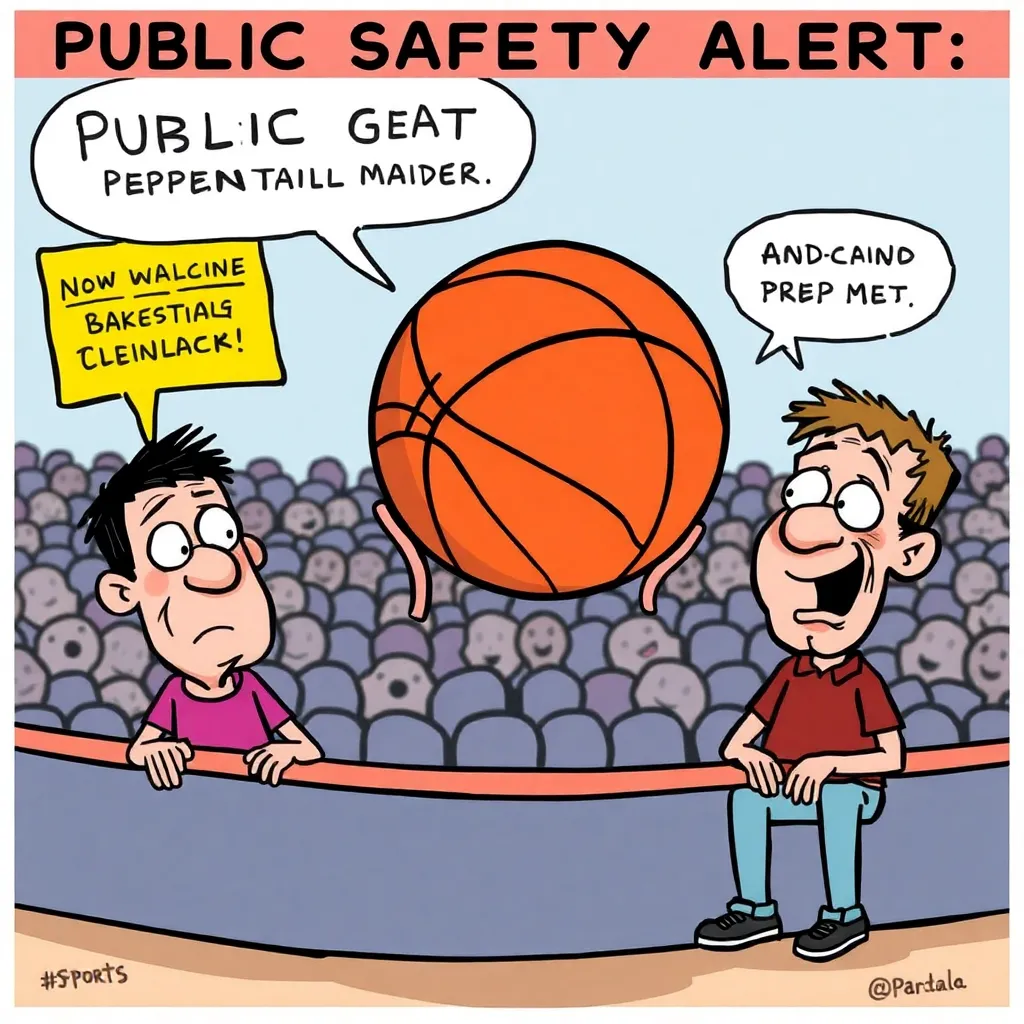
ATLANTA — The National Consortium for Spherical Athletics Research (NCSAR) issued an urgent public safety advisory Tuesday following the release of a landmark 340-page peer-reviewed study confirming that basketballs, when dribbled, travel downward toward the floor before traveling upward again, a pattern researchers say repeats at a frequency that some participants found 'difficult to process without preparation.
The study, titled 'Vertical Oscillation in Handheld Inflated Spheres During Competitive Lateral Movement: A Preliminary Concern,' was conducted over four years at eleven universities, involved 2,400 hours of high-speed video footage, and cost an estimated $4.7 million in federal grant funding. Its central finding — that the basketball goes down and then comes back up, again and again, for the duration of a game — has sent shockwaves through the athletic community.
'What we observed was consistent, reproducible, and deeply unsettling once you really sit with it,' said Dr. Pamela Ostritch, NCSAR's Director of Gravitational Sport Events and the study's lead author. 'We are not saying people should stop watching basketball. We are saying they should know what they are watching. The ball is going to go down. Then it is going to come back up. Then it is going to go down again. This will happen hundreds of times. We felt the public deserved to be told.'
The advisory, which has been distributed to all 50 states and three territories, recommends that arena attendees be given a brief verbal orientation before tip-off, including a calming description of the bounce cycle, a laminated reference card illustrating the ball's trajectory, and access to a designated Oscillation Recovery Zone staffed by licensed counselors and at least one person who has 'seen a lot of games and is fine.'
The NBA released a statement saying it was 'aware of the research and taking it seriously,' while noting that dribbling had been occurring at the professional level since 1946 without a formal advisory, a period it described as 'a gap we are committed to closing in a measured and revenue-neutral way.'
Not all experts agreed the findings warranted emergency designation. Dr. Carl Wentz, Professor of Obvious Mechanics at the University of Ohio's Department of Things That Were Already Happening, called the advisory 'well-intentioned but slightly aggressive.'
'The ball bounces,' Dr. Wentz said. 'That is the thing. That is the whole thing. I want to be respectful of my colleagues' work, but I did know this. My nephew is nine and he also knew this. We talked about it.'
Dr. Ostritch pushed back firmly. 'With respect to Dr. Wentz, knowing something casually and knowing it scientifically are not the same,' she said. 'We have charts now. The charts show the down and then the up. No one had charts before. That is the contribution.'
The NCSAR says a follow-up study is already underway examining whether the ball, once released toward the basket, either goes in or does not go in, findings it expects to publish by late 2027. Citizens are advised to remain indoors near hardwood flooring and exercise caution.