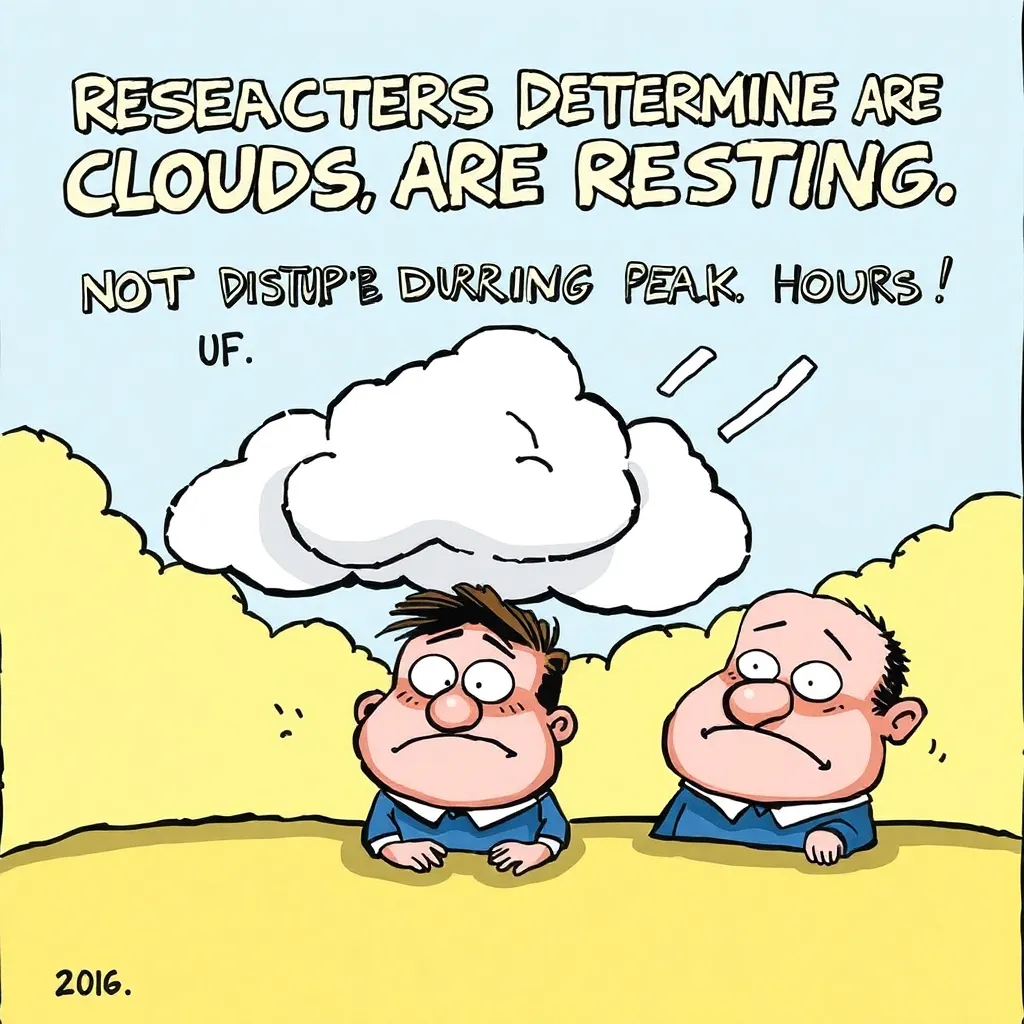
Researchers Determine Clouds Are Resting and Request Public Not Disturb Them During Peak Hours
GENEVA — A coalition of thirty-seven internationally recognized geologists, funded by an emergency grant from the United Nations Department of Things That Seem Fine But Probably Aren't, has published a landmark 400-page peer-reviewed study concluding that the Earth's mountains are the direct result of the planet periodically holding its breath.
The study, titled 'Topographical Anxiety and the Respiratory Patterns of a Stressed Planet,' was released Monday and has already drawn widespread alarm from the scientific community, several continental governments, and at least one man in Colorado who said he 'had a feeling.'
'When you look at the data, it's genuinely inescapable,' said Dr. Fennimore Clutch, lead author and chair of Applied Terrestrial Nervousness at the University of Maastricht. 'The tectonic record clearly shows rhythmic compression events consistent with what we, in the field, call a big inhale-and-hold situation. The Earth breathes in, gets anxious, forgets to breathe out, and you get the Alps. It's really very simple.'
The report identifies the Himalayas as a particular point of concern, noting that their extreme elevation suggests the Earth has been holding that specific breath for approximately 50 million years. Researchers described this as 'not ideal' and said it 'warrants a conversation.'
'We're not saying panic,' said Dr. Lutece Vanderbrook, the study's co-author and Director of Geological Emotional Intelligence at Delft Institute. 'We're saying the planet is clearly going through something, and perhaps we could all just be a little more supportive. Maybe stop digging so much. Let it talk.'
The study proposes that flat plains and plateaus represent moments when the Earth successfully exhaled, which researchers are characterizing as 'encouraging' but 'frankly rare.' Kansas, according to the paper's appendix, is the Earth's most relaxed region, a finding that surprised no one who has driven through it.
The United Nations has convened an emergency panel to study the implications, though sources inside the session report that delegates spent the first two hours debating whether comforting a planet falls under environmental policy or mental health appropriations.
The report recommends several immediate measures, including a global moratorium on mountain climbing described as 'essentially poking someone in the ribs while they're already stressed,' a pilot program of what the authors call 'ambient geological reassurance,' which involves playing soft music near fault lines, and a formal international agreement to stop referring to volcanoes as 'blowing their tops,' which the study says is 'stigmatizing language around a very difficult coping mechanism.'
Not all experts are convinced. Dr. Harriet Bloom of Oxford's School of Normal Geology called the study 'categorically insane' in a statement, before adding, 'Although I will say the Andes have always given me a bad feeling, personally.'
The paper concludes with a direct message to the planet itself, printed in the final paragraph in bold: 'You are doing great. Please exhale when you are ready. We have cleared the Netherlands just in case.'
Publication in the journal Nature is pending. The mountains have not commented.