Researchers Identify Invisible Gas Released By Shopping Carts Upon Contact With Hands, Classify It As 'Mild Grievance Vapor'
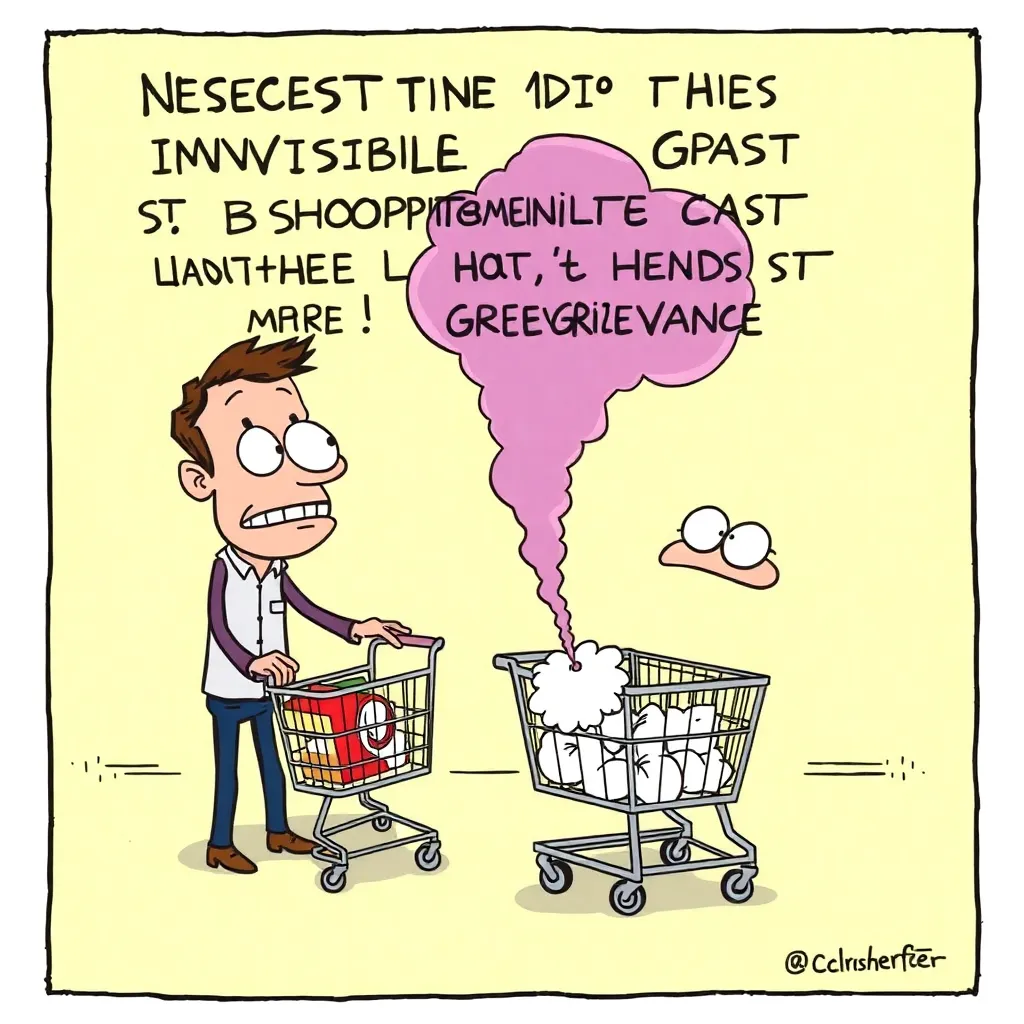
MILLHAVEN — In findings described by lead researchers as 'both groundbreaking and deeply unsurprising,' scientists at Brauner-Holloway Community College's Department of Applied Situational Acoustics have confirmed that grocery store parking lots across the tri-county area emit a low-frequency hum capable of eroding human patience at a rate previously only observed in DMV waiting rooms and family holiday dinners.
The study, published Tuesday in the peer-reviewed journal Peripheral Stressors Quarterly, tracked 340 adult volunteers across 18 local grocery store parking lots over a period of six months. Using modified refrigerator thermometers and what the research team described as 'a lot of intuition,' scientists measured what they are calling Ambient Grievance Frequency, or AGF, and found consistent readings spiking whenever more than two vehicles attempted to navigate the same lane simultaneously.
'What we're seeing is a harmonic convergence of poor lane design, inexplicable cart corrals, and one guy idling for eleven minutes waiting for a spot that was never going to open up,' said Dr. Patrice Wumble, the study's principal investigator and a woman who admitted she has personally circled the Millhaven Foods parking lot 'more times than I am professionally comfortable disclosing.'
The Millhaven Office of Public Readiness has issued a four-tier Public Safety Alert in response to the findings, ranging from Tier One, described as 'mild sighing,' to Tier Four, which officials defined as 'audibly narrating the failures of strangers to no one in particular.' As of press time, the greater Millhaven metropolitan area is operating at a sustained Tier Two, with isolated Tier Three incidents reported near the cart return at Harvest Glen SuperFoods on Route 9.
'We want to be clear: this is not an emergency,' said Deputy Public Readiness Coordinator Gerald Foss at a press conference held, somewhat ironically, in the parking lot of Town Hall. 'This is more of a chronic, low-grade situational hazard that has always been there and that we have simply now given a name. We feel naming it is the first step. The second step is unclear at this time.'
Researchers are recommending residents adopt what they are calling a Patience Conservation Protocol, which includes: entering the parking lot with no fewer than two alternate routes mentally prepared, avoiding eye contact with anyone whose blinker has been on for more than 30 seconds, and 'accepting that the compact car space is never going to be correctly used by anyone, ever, and releasing the anger associated with that truth.'
Dr. Wumble noted that the hum appears to dissipate entirely once individuals are inside the store, only to reconstitute at full intensity upon return to the parking lot, particularly if the person discovers the cart they left at their trunk has rolled seventeen feet into a neighboring vehicle.
'We believe the lot itself is the source,' Dr. Wumble said. 'The asphalt, the painted arrows no one follows, the inexplicable speed bumps placed where no speed has ever been achieved — it all contributes. This is a built environment optimized, accidentally, for the production of low-level human suffering.'
The study received $4,200 in funding from a local hardware store whose owner wished to remain anonymous but confirmed he has 'strong feelings about the ShopRite on Clement Avenue specifically.'
Residents are encouraged to report Tier Three or above incidents to the Public Readiness hotline, which, officials confirmed, currently has a hold time of approximately 22 minutes.