Town's Bird Population Found To Be Using Electrical Infrastructure For Personal Use, Utility Board Convenes
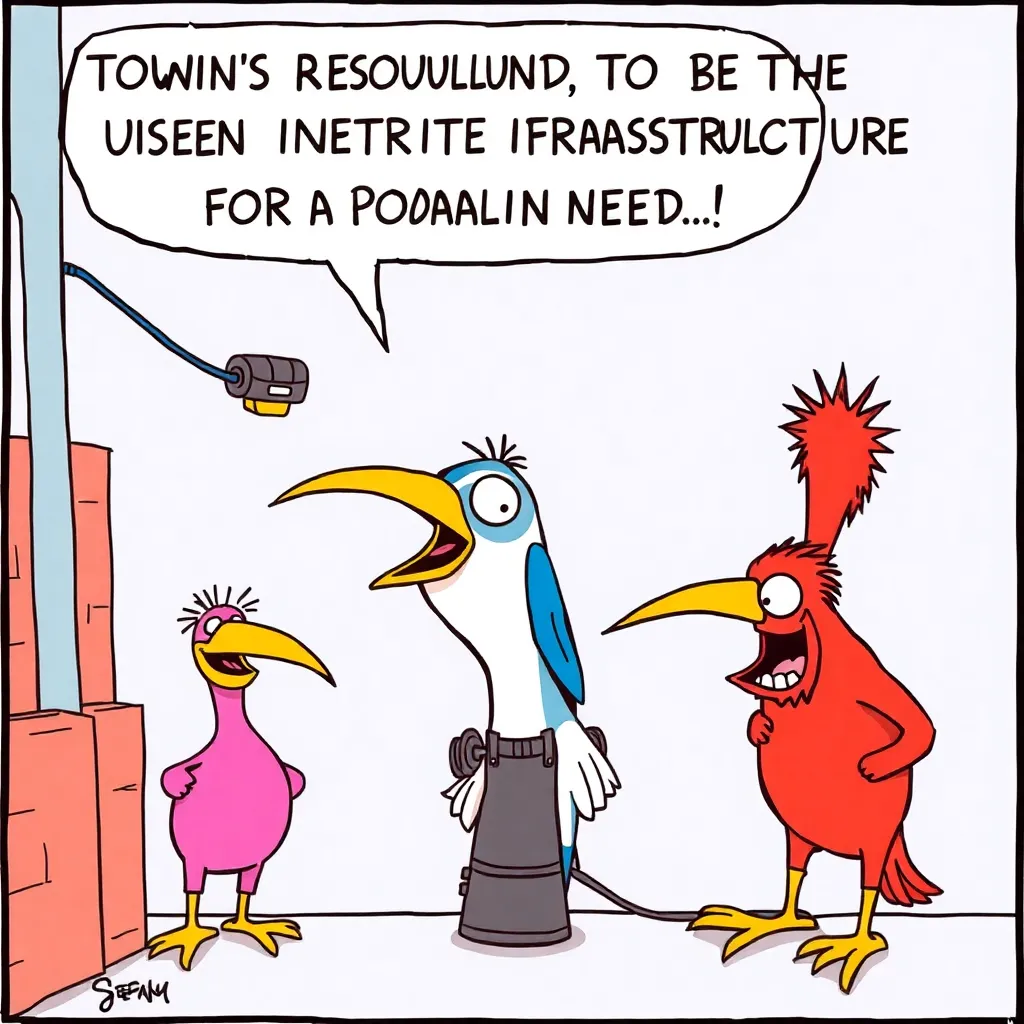
MILLHAVEN — A team of researchers at Millhaven Community College's Extension Program for Outdoor Sciences has released findings this week that experts say could fundamentally reshape how residents of the greater Millhaven area look at the birds sitting on the electrical wires above Cranbrook Avenue.
According to the study, birds perching in a row on power lines are engaged in a deliberate and necessary charging process, drawing low-level electrical current up through their feet in order to sustain basic biological functions including flight, chirping, and what researchers described only as 'the looking around they do.'
'We've known something was going on for a long time,' said Dr. Patricia Vohl, the study's lead author and coordinator of the college's two-credit Wildlife Observation certificate program. 'You don't just sit on a wire like that for no reason. That's not resting. That's charging. We have charts.'
Dr. Vohl added that smaller birds typically reach a full charge within forty-five minutes, while larger birds such as crows and what she referred to as 'the big brown ones' may require upwards of two hours depending on ambient humidity and how much they flew the previous day.
The findings have been embraced enthusiastically by local television station WMLH, which aired a twelve-minute segment Tuesday evening under the graphic 'WIRE BIRDS: WHAT THEY NEED FROM US.' Anchor Dale Putnam described the study as 'one of the most important things to come out of this zip code in recent memory.'
The report has also prompted a formal response from Millhaven's Public Utilities Coordinator, Roger Fennick, who confirmed that the town has no current policy addressing avian use of municipal electrical infrastructure and that a subcommittee has been formed to begin drafting one.
'We're not saying the birds are stealing power,' Fennick told reporters outside Town Hall. 'We're saying the conversation needs to happen.'
Not all experts are aligned on the details. Gerald Pruett, a retired high school science teacher who has been cited in three separate WMLH segments this year, expressed some skepticism about the charging timeline but agreed with the study's overall conclusion.
'I think the smaller birds are probably done faster than Dr. Vohl estimates,' Pruett said, speaking from his driveway. 'Sparrows especially. Very efficient little guys. I've watched them.'
Residents along Cranbrook Avenue say the study has changed how they interact with the birds. Local homeowner Diane Schuppert, 61, said she now waits until the birds leave on their own before using her leaf blower.
'I didn't know before,' Schuppert said. 'I thought they were just sitting there. I feel terrible about the leaf blower.'
Dr. Vohl says the team plans a follow-up study examining whether birds that fall off the wire mid-charge experience any lasting effects, and whether the brief head-tilt behavior observed in starlings constitutes a full restart or simply a settings adjustment.
The study is available for review at the Millhaven Public Library's periodicals desk. A laminated summary has been posted at the entrance to Hendricks Park near the duck pond, where, officials note, a separate but related investigation is already underway.